
Ministries
Resources
Calvin R. Goligher
New Horizons: October 2026
Also in this issue
by Brian L. De Jong
by Everett A. Henes
by Judith M. Dinsmore
In the early twentieth century, a rising tide of liberalism swept over churches in Europe and North America, and the Presbyterian churches were not spared. The leading centers of biblical and theological scholarship, especially in Germany, were shaping church leaders according to prevailing modern trends, which on many points were opposed to Christian orthodoxy. This gathering storm broke in the 1920s, and Princeton Seminary professor J. Gresham Machen emerged as a key leader in the high-stakes effort to prevent liberalism from capturing the American Presbyterian church.
One of Machen’s students at Princeton, W. J. Grier, led a similar effort in his home country of Northern Ireland. Like Machen, he combined a brilliant mind with a firm commitment to orthodox Reformed doctrine, which he courageously defended at great personal cost. Actually, Grier’s experience in Northern Ireland foreshadowed events in Machen’s ministry. A decade before Machen founded the OPC, Grier joined in establishing the Evangelical Presbyterian Church of Ireland. Almost a century later, this denomination and the OPC are sister churches, seeking to serve Christ faithfully according to the Bible and the Westminster Standards.
In the early twentieth century, theological liberalism presented an enormous challenge to Christian doctrine. Capitulating to modern intellectual fashions, liberal theologians rejected the supernatural elements of Christianity and refashioned the whole Christian faith along the lines of rationalism and materialism.
Faithful ministers and churches found it difficult to address the problem because liberals redefined familiar Christian terms to fit their agenda. For instance, liberals spoke of “the inspiration of Scripture,” though they did not regard the Bible as a supernatural divine revelation. Instead, they used the term “inspiration” to describe the Bible as a product of spiritually exalted human thought. In a similar way, liberals preached about the cross of Christ, but they rejected the traditional doctrine of penal substitutionary atonement. They did not see Christ’s death as a sacrifice offered to God in the place of sinners to offer forgiveness by satisfying divine justice; rather, they understood it simply as a display of sacrificial love to humanity.
This rising tide of liberalism affected Presbyterian churches and seminaries not only in America but also in Canada, Scotland, and Ireland. While leading ministers embraced these errors, some church members and leaders continued to believe and teach traditional orthodoxy, and many wavered in between. It remained to be seen whether faithful ministers and elders, with the support of their congregations, could keep their institutions faithful to biblical orthodoxy.
William James Grier grew up attending a Presbyterian church in the little town of Ramelton in County Donegal. He was converted to saving faith in Christ in 1922 while studying at Queen’s University, and soon he was interested in preparing for the gospel ministry. Grier wanted to study at a seminary that would uphold orthodox doctrine, so he applied to Princeton Theological Seminary, where Machen was a professor of New Testament. He set out for America in 1923, the same year that Machen published Christianity and Liberalism. That work was a clarion call against liberalism, but especially against conservatives who thought it best to cooperate with the liberals. Machen argued that there could be no cooperation, and he called on his readers to bravely defend true Christian doctrine, even at personal cost.
Machen and the other Princeton professors shaped Grier profoundly. From them, Grier learned sound doctrine, along with the skills and insights he would need to lead the church in years to come. Machen’s influence on Grier was not only academic. He mentored Grier in more practical aspects of ministry, and he helped Grier find summer ministry internships in Canada. The year was 1925, and a large liberal segment of the Presbyterian Church of Canada had just decided to join the even more liberal Methodist Church in forming the United Church of Canada. This was a major institutional victory for liberalism in that country, even though many faithful congregations and ministers remained Presbyterian. Machen helped the continuing Presbyterian Church of Canada in various ways, particularly with recruiting ministers. Grier’s summer internships were an example of Machen’s international vision and his personal investment in the formation of future ministers.
Grier completed his studies in 1926 and returned to Northern Ireland. The mutual appreciation of student and professor had grown into a personal friendship, which led them to correspond frequently. This friendship was no doubt all the more important to the two men as they each faced the challenge of resisting liberalism in their churches. It was a modest international partnership in defense of orthodox, Reformed doctrine and ministry.
When Grier returned to Northern Ireland, he was required to attend another year of theological study at the Presbyterian College in Belfast (today, the institution is known as Union Theological College). Grier was deeply troubled by what he heard from the professors, particularly a professor of church history, James Ernest Davey. In class lectures, Professor Davey and others denied the deity of Christ, the infallible authority of Scripture, and other key Christian doctrines.
Grier brought his concerns to James Hunter, a minister in the Presbyterian Church of Ireland. Hunter later recalled this pivotal moment: “A young theological student told me that he had been taught by his professors that the Lord Jesus on the Cross thought He had let God down” (Ernest Brown, By Honour and Dishonour, 109). Hunter decided to bring a charge against Davey. In fact, he brought five, alleging that Davey was teaching error related to (1) the doctrine of justification, (2) Christology, (3) Scripture, (4) sin, and (5) the Trinity. The Belfast Presbytery judged Davey “not guilty” on all five charges. Hunter appealed to the general assembly, but Davey’s acquittal was upheld. The case was major news in Northern Ireland, and the outcome meant that the Presbyterian Church of Ireland had clearly advertised its acceptance of serious liberal error within its ranks.
The trial and subsequent appeal were a difficult experience for Hunter, who was almost a lone voice in his presbytery. It was also difficult for Grier, because much of the evidence came from his notes and memories of what Davey had said in class. Grier’s sacrifices did not escape Machen’s notice. He said: “Heroic work has been done by Mr. Grier our Seminary graduate. . . . He has thrown away all his ecclesiastical prospects for the sake of the cause. . . . Most of the pulpits, of course, are closed to him” (quoted in Brown, 161).
Machen had firsthand acquaintance with these events because he visited Northern Ireland in June 1927, just days before the general assembly took up Hunter’s appeal. During his visit, Machen spoke at special services on the theme “What is Christianity?” On Sunday, he preached to a large Belfast congregation in the morning and in the evening at a large hall packed with sixteen hundred people from the area. Machen observed that
the ministers (with few exceptions) are standing on the Modernist side in the ecclesiastical fight; but there is a tremendous tide of evangelical and polemically anti-modernist sentiment among the laity. In the last five years a real revival of religion has been going on. It has been discouraged in every possible way by the great mass of the ministers. (Brown)
In the aftermath of the appeal, James Hunter resigned from the ministry of the Presbyterian Church of Ireland. Machen noted in a letter to Grier that Hunter’s decision “was taken because of an unselfish and wholehearted devotion to Christ, which is a rebuke to many of us in these sad days.”
In November 1927, Hunter led the formation of a new church, called the Irish Evangelical Church. The new church was small, with no buildings or money, and few friends. Hunter was the only minister until Grier was ordained in 1929. Instead of the Westminster Confession, Hunter proposed eight brief articles of faith as the new church’s doctrinal basis. Hunter was likely reacting against his difficult experience in the Presbyterian Church where the Westminster Confession did not protect the church from being captured by liberals.
Grier had a more balanced perspective, no doubt reflecting the formative influence of Machen and other Princeton professors. From the start, Grier was in favor of adopting the Westminster Confession as the church’s doctrinal standard. In 1933, the church faced a controversy over dispensationalism, which it could not adequately address from its brief articles of faith. In that context, Grier successfully moved to adopt the Westminster Assembly’s catechisms. By that time, Hunter’s thinking had changed, and he now saw the need for a larger confession of faith. Decades later, this maturing perspective was reflected in a name change from the Irish Evangelical Church to the Evangelical Presbyterian Church of Ireland.
In the years since, the Evangelical Presbyterian Church has continued ministering God’s Word faithfully. It remains a small church, even in the context of Northern Ireland, population two million. The small country experienced frequent political violence during the Troubles of the 1960s to 1990s, motivated by religious, ethnic, and political grievances.
Overall, the spiritual and ecclesiastical trend has not been encouraging in the entire United Kingdom or in the Republic of Ireland. Around the middle of the twentieth century, ministers like Martyn Lloyd-Jones witnessed great spiritual harvests in England and Wales, but the longer pattern has been a rising secularism. Through it all, the Evangelical Presbyterian Church has carried on an energetic program of youth ministry, evangelism, church planting, and foreign missions.
In doctrine, ministry, and church leadership, Grier followed a very similar path as his beloved professor Machen. Indeed, at some points, Machen followed a path laid down by Grier. The young student Grier was a witness in a case against a liberal professor who was unjustly acquitted. Machen had it the other way around when he faced charges from liberal colleagues and was unjustly deposed. Both cases revolved around fundamental articles of Christian doctrine that brook no agreement with modern rationalism and materialism.
Grier and Machen shared a commitment to the whole system of Reformed doctrine over against errors like dispensationalism. They imparted that commitment to the churches they helped to establish. In the 1940s, Grier published The Momentous Event, an excellent book on the second advent of Christ, no doubt motivated by his experiences with controversy over dispensationalism. Likewise, Machen’s call for full-orbed confessional orthodoxy was a major element in the OPC’s rejection of dispensationalism in its first few years as a new church.
Machen’s ministry came to a sudden end when he died in 1937, just one year after the founding of the OPC. Happily, Grier had a much longer ministry, continuing until he retired in 1979, a few years before his death in 1983. Presbyterians in Northern Ireland and America alike have many reasons to cherish the legacy of these men, forged by their faithfulness and courage in the international Presbyterian controversy with liberalism.
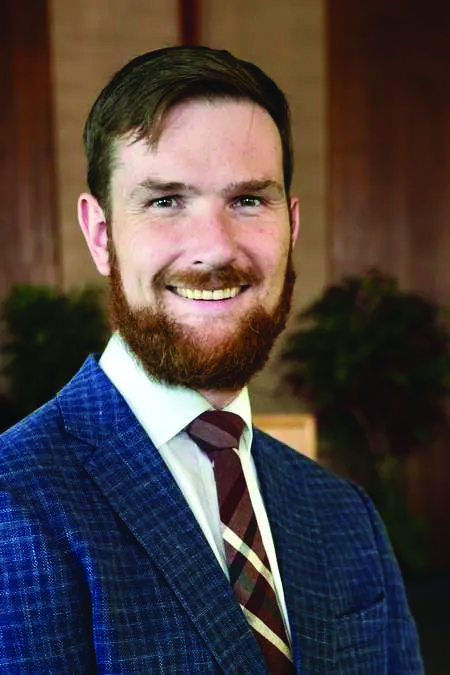
The author is pastor of First OPC in Sunnyvale, California. New Horizons, October 2026.
New Horizons: October 2026
Also in this issue
by Brian L. De Jong
by Everett A. Henes
by Judith M. Dinsmore
© 2026 The Orthodox Presbyterian Church


