
Ministries
Resources
Judith M. Dinsmore
New Horizons: October 2026
Also in this issue
by Calvin R. Goligher
by Brian L. De Jong
by Everett A. Henes
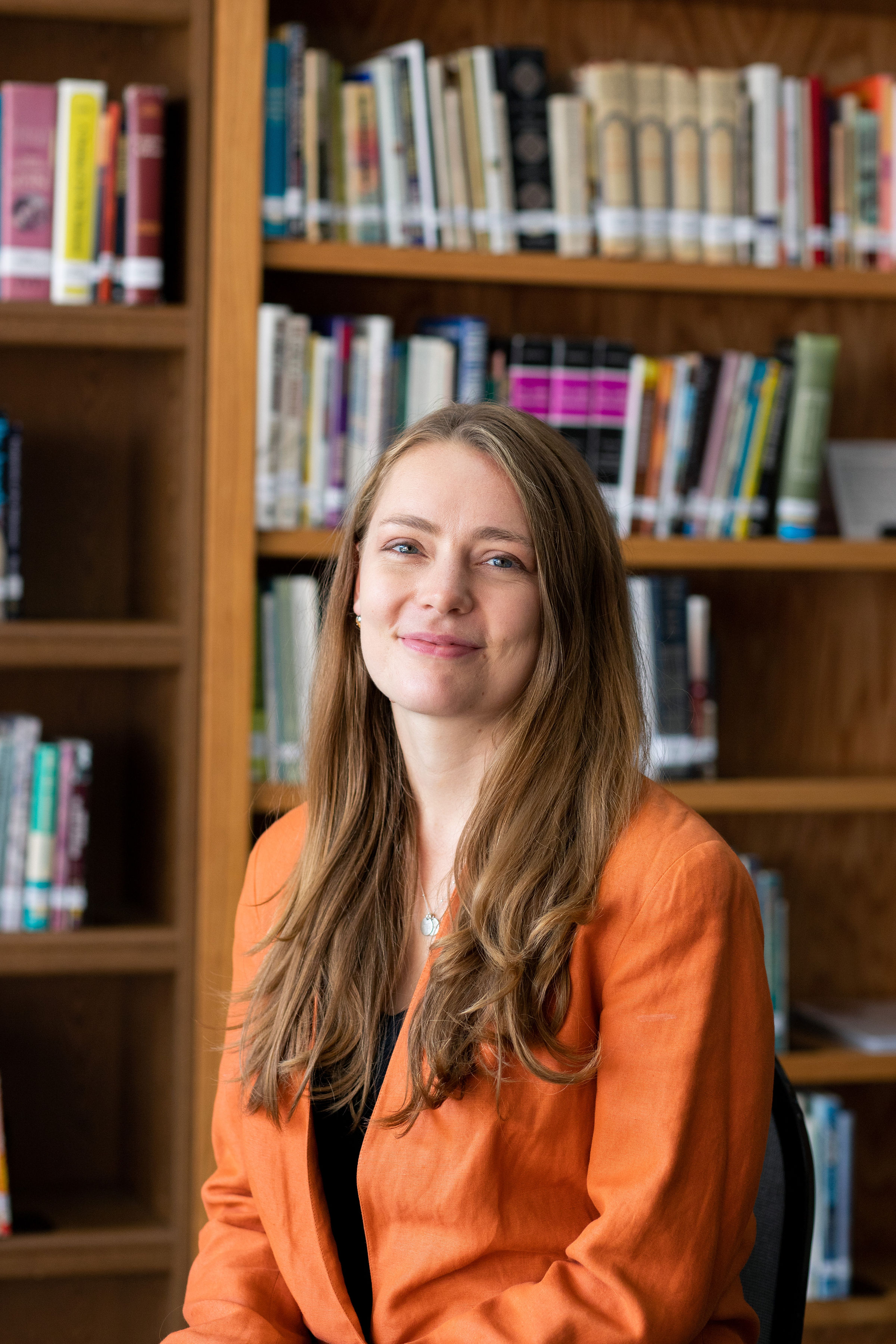
Mark Aharkov directs a food distribution center on behalf of the evangelical and Presbyterian church where he is a member in Kharkiv, Ukraine’s second largest city. Aharkov’s office is about fifteen miles from the Russian border.
Last spring, David Nakhla traveled to Kharkiv with three others from the OPC to encourage Aharkov and Kharkiv Presbyterian Church and to observe its distribution center, which receives funding from the OPC’s Committee on Diaconal Ministries through the Ukraine Crisis Fund.
Nakhla was amazed. “In this city of 1.5 million people, they’ve become known as the premier ministry—that’s their reputation. There’s a lot of accountability not only for donors, but with the governing authorities,” Nakhla said. “They intentionally seek to dignify the people who are receiving assistance. . . . [and] it’s very connected with the church.”
Families can apply for aid once every three months. If accepted, they receive an appointment between 10 and 4 on Saturdays to receive a bag of food, enough to last for two weeks, and, if needed, clothing and household goods as well. Volunteers from Kharkiv Presbyterian Church explain to clients who they are—not a charitable foundation or a government institution, but a church. They share the gospel and invite clients to attend worship.
“We are helping in the name of Jesus,” Aharkov said. “Very often [clients] are crying, and I appreciate our team members who can talk and pray and feel their pain.”
Nakhla noted the high quality of the clothing and the food. That sends a message about the church and about Christ, Aharkov explained: “I saw a lot of charitable organizations distribute very low-quality products because they are cheaper.” But if he would not buy his own kids the food—Aharkov has three little boys—he does not buy it for the center’s food bags. That means they give good stuff: jam, canned fish, ham, and even milk, and not just basic cereals and oil.
Government aid in Ukraine right now relies on foreign aid, which can be clumsy. In contrast, their church’s social center has boots on the ground and sees the problem from the inside. “We’re not just making reports, but meeting people and sharing the love of Christ,” Aharkov said.
How did a small Reformed church of around fifty members come to have a food distribution center that is still open when many others have closed and, more than that, is known as one of the best in the city?
When Aharkov talks about the church that has been his home since adolescence, he refers to “before the war” and “now.” Before the war, Kharkiv Presbyterian Church, a member church of the denomination begun by MTW missionaries in the nineties, had a young congregation filled with students from Kharkiv’s many universities. Before the war, the church was saving to buy its own building.
Before the war, its efforts centered on education, conferences, and evangelism to students.
Then in February 2022 Russia invaded Ukraine. Its military quickly moved to take Kharkiv, surrounding it on three sides. The church put into action its evacuation plan.
Aharkov himself was pursuing a master’s degree in Lithuania when Russia invaded, and could have stayed. Instead, within a few weeks of the invasion, he and six other men, including the church’s pastor, felt that they must begin to help. They began gathering food and medicine and delivering it to Kharkiv, and then bringing evacuees from Kharkiv back to western Ukraine and other safer areas. Because of the active fighting, pharmacies and grocery stores were closed. There was no public transportation and limited gasoline. The streets were empty; everyone still in the city was hiding in bomb shelters. “It was total chaos,” Aharkov remembered. “We just started helping people. We moved tons of food.”
In the summer of 2022, Aharkov moved back to Kharkiv full-time. The church bought groceries with the money it had been saving for a new building. They opened a warehouse and the social center. Aharkov was receiving funds from everywhere, and he wrote a daily report to donors with updates on the war and on the church’s mercy efforts. He arrived at the center once at 9 a.m. to see over a thousand people lined up, and they weren’t quiet. Aharkov set up an appointment system and began to triage based on need, helping the disabled and elderly and displaced. Kharkiv is full of people from the surrounding regions of Donetsk and Luhansk who fled villages that were “wiped off the face of the earth,” as Aharkov put it.
In September 2022, the Russians were pushed away from Kharkiv. Today, food, medicine, and gas are available locally again; buildings in Kharkiv are repaired, although boarded-up windows remain on most blocks; and restaurants and even the city’s famous zoo have reopened. Air raid sirens are nearly constant, yet everyday life continues.
But the church has changed. The average age of church members has “jumped twenty years,” Aharkov said. Whereas many younger people have moved to less dangerous cities, the elderly are often not so ready to adopt a new home. (“We have deep roots,” as one woman told Aharkov.) Some forty or fifty people who were clients of the center are now members of the church—many of them first-time believers. Long-time church members who weren’t involved in ministry before the war are now “very active,” helping with the distribution on Saturdays.
Aharkov has changed as well. Before the war, “struggling and pain were far away,” he said. “These vulnerable [people] weren’t in my focus or attention.” But the war’s destruction has opened Aharkov’s eyes to suffering and made him ask what a Christian response ought to be. “[The war] revealed to me Jesus Christ from a different perspective. He talked about the kingdom of God. But he also
fed people.”
Aharkov and his wife are committed to staying in Kharkiv with their twin two-year-olds and baby to provide help in Christ’s name. They were encouraged by Nakhla’s visit—only the second group of non-Ukrainians to come since the war began. Aharkov said that the group was brave to visit Kharkiv, and when I pointed out that he is the one who lives in the city, he laughed. “For us, it’s just normal,” he said.
The church is eager to expand the social center. Even if the war ends soon, economic disruption will continue, and the numbers at their center may even swell. However, the cost of the food bags has grown from twelve dollars to twenty-five, and donations are down. Right now, the center can only provide aid for two hundred families per month. They would like to do much more.
Right before my call with Aharkov, a man had knocked on the center’s door. He was a soldier around thirty years old, he was missing an eye, and he was hungry. “This man gave his health for his country, and he did not have food to eat. This is a really big problem,” Aharkov said.
But as Mark Aharkov and Kharkiv Presbyterian Church show the mercy of Christ in a time of war, their confidence is that the Lord will provide.
The author is managing editor of New Horizons. New Horizons, October 2026.
New Horizons: October 2026
Also in this issue
by Calvin R. Goligher
by Brian L. De Jong
by Everett A. Henes
© 2026 The Orthodox Presbyterian Church


