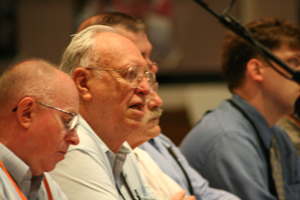
2007 General Assembly Report
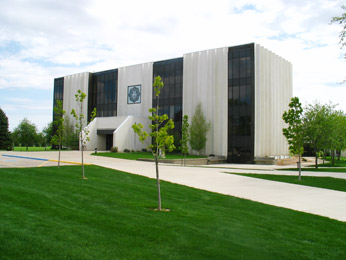
The Seventy-fourth General Assembly is meeting at Dordt College, Sioux Center, Iowa, beginning at 7:00 p.m., Wednesday June 13, 2007, with a terminus no later than noon, Wednesday June 20, 2007. This running daily report is being written by David K. Thompson and edited by Stephen Pribble and Linda Foh. Questions or comments may be addressed to the Rev. Donald J. Duff, stated clerk. Refresh your browser to see the latest version (choose View, Refresh or View, Reload page). Jump to Thursday, Friday, Saturday, Monday, Tuesday, Wednesday. To go to a slide show of photos from the General Assembly, click here.
Wednesday June 13, 2007
The weather that greeted us upon arrival at Dordt College in Sioux Center was not Iowa's best. A steady downpour caught travelers off guard. For some, this meant having to move quickly from building to building without umbrellas; for others, it meant delayed flights and slow commutes from the closest airports in Sioux Falls, South Dakota or Omaha, Nebraska.
But in spite of the weather, many were still able to attend this year's pre-Assembly conference, themed around helping commissioners understand and appreciate the importance of parliamentary procedure for bodies like the Assembly. The Rev. Alan Strange delivered the keynote address. We Presbyterians are very concerned about doing things the right way, especially when it comes to General Assembly. But we order our meetings not because we are mandated to do things "decently and in order," but instead so that we may properly esteem one another. "Decently and in order" is our standard for worship; though a vital mandate for the worship context, it is not normative for other contexts. Instead, our guiding principle must be the respect and love that we are commanded to provide for our brothers in the Lord. A rule framework (like Robert's Rules of Order, upon which we rely) enables us to safeguard this principle.
The rain continued, as did a steady flow of commissioners, corresponding members, and fraternal delegates. By the time the gavel fell at just after 7:00 p.m., approximately 121 of the approximately 138 commissioners expected had arrived. It was then that the dreariness of the rain clouds truly began to subside. The opening prayer, the first hymn, the sermon from the Rev. Dick Gerbertogether these refrains pointed those gathered to heaven.
The goodly land I see, with peace and plenty bless'd; A land of sacred liberty, and endless rest. There milk and honey flow, and oil and wine abound, And trees of life forever grow with mercy crowned.
Using Luke 15 as his text, Mr. Gerber reminded us that the three parables found here are our Lord's response to the scoffing Pharisees and Scribes, who grumbled as Jesus met with the tax collectors and sinners who had gathered to hear him. In each parable something is lost: a sheep, a coin, a son. And when that which was lost is found, there is rejoicing. The shepherd calls his friends and neighbors. The woman calls her friends and neighbors: "rejoice with me, for I found that which was lost." Likewise the father calls to his servants to bring the best and kill the fatted calf. There was to be a celebration. To remove doubt as to the meaning of these parables, Jesus applies them for us. The sheep? "I tell you that in the same way, there will be more joy in heaven over one sinner who repents than over ninety-nine righteous persons who need no repentance" (v. 7). The coin? "In the same way, I tell you, there is joy in the presence of the angels of God over one sinner who repents" (v. 10). And while Christ provides no explicit application with the last parable, the story of the prodigal son points us to the heavenly Fathera Father who watched his children reject himbut that Father calls the church to rejoice over the sinner that repents. Indeed, here we see God's heart and God's attitude. He sent his Son to seek and to save that which was lost. With the realization of this purpose he rejoices, and he calls us to rejoice with him and to share his joy. God says to us, "I have given my Son; together we've sent our Spirit, and he enables you to rejoice over those that are found." Gerber's concluding prayer placed a poignant exclamation mark on what should be our attitude: "We are humbled that you rejoiced over each one of us."
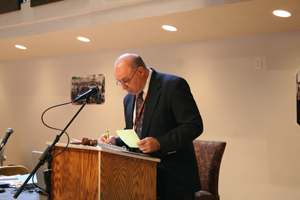
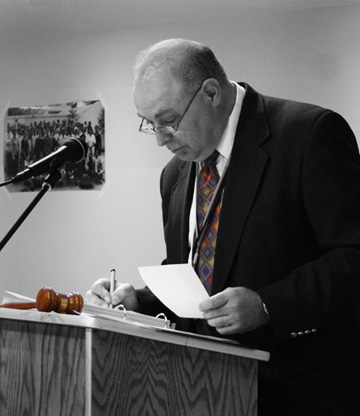
Moderator Eckardt
 |
This year, as last, the Assembly started regular business in earnest immediately after the sermon. The first order of business was to elect this year's moderator. As two very able men were nominated, a vote was necessary. While there have been and will be many elections at OPC assemblies, this one was something of a watershed, as we experienced the wonders of modern technology. For the first time, the Assembly completed a vote using electronic voting devices. Each commissioner received a small credit card sized device, much like a small remote control, but without a channel selector, volume control or, a mute button. Upon instruction, we each pressed the button corresponding to the candidate we desired, and the votes were automatically tallied and displayed on the screen within seconds. The result? The Rev. Robert Y. Eckardt (pastor of Redeemer OPC in Dayton, Ohio and current moderator of the Presbytery of Ohio) was elected. As he took the gavel from Mr. Gerber, he thanked the Assembly and noted the significance of the venue. He was especially grateful for the opportunity to serve the Assembly at Dordt. He had siblings attend the school, and onehis brother Doug, who passed away 10 years agohad his memorial service in the very chapel in which we are meeting.
After the gavel passed, a few remaining items of business were conducted before the Assembly adjourned for the evening. First, the remaining agenda was approved, and second, we agreed upon advisory committee assignments. It is these committees that will occupy the Assembly for the next day.
Thursday June 14, 2007
Thursday is Advisory Committee (AC) day. For the vast majority of commissioners, this means intense focus on a smaller set of issues in smaller groups. It also means that there is little activity on the floor of the Assembly.
AC duties began promptly at 8:30. I cannot report on the work of all committees, as I was only involved in two. I was assigned to AC 1, which is charged with reviewing the work of the Committee on Foreign Missions (CFM). It is always a joy to hear of God's work in his people around the world, especially when we can with confidence know the he has raised up for himself men dedicated to gospel proclamation. AC 1 met with Mark Bube (general secretary of the CFM), Doug Clawson (associate general secretary), and CFM representatives Gary Davenport and Paul Browne. We also had the added blessing of hearing directly from Bob Wright, a deacon currently serving in Uganda, helping not only the missionary families with the very practical needs, but also teaching the indigenous population agricultural and carpentry skills. Bob's enthusiasm for the work is contagious, and hearing him we could not help but get excited about the good things that God is doing through Orthodox Presbyterian efforts.
I also had the duty to sit on the other side of the table for AC 7, which reviews the labors of the denomination's historian (John Muether) and the work of the Committee for the Historian. Together with fellow committee member Brent Ferry, Mr. Muether and I met with AC 7 for a short time and reviewed not only our efforts since the last Assembly, but also projects which are currently underway or planned in the near future. Of note is our recent publication, The God-Breathed Scriptures, released in celebration of the centennial of E. J. Young's birth. The short book contains a recently-rediscovered series of four lectures that Young delivered in 1966 on the doctrine of Scripture. Each commissioner will receive a free copy!
GA Commissioners
 |
The Assembly convened as a whole only once today, at 11:55, for our daily devotional. The Rev. S. Scott Willet read from Revelation 21:1-3, and engaged us with the challenge to embrace a genuine love for Christ's church: "If there is only one thing that I want to be known for," opened Mr. Willet, "it is this: that my ministry has brought about a genuine love for the family of God, the church." It is the church that is the body of the redeemed, and it is through the church that we get a glimpse of the eternal blessings that will be ours through our union with Christ. The language of John in the text paints a very poignant portrait for us: the church, that is, "the holy city, the new Jerusalem," is described as "a bride adorned for her husband." The bride does not adorn herself for herself, but instead for her husband, to please the bridegroom and to bring him honor. So too, we, the church, the bride of Christ, must adorn ourselves for our bridegroom and delight ourselves in his glory. To read Mr. Willet's sermon, click here.
At the conclusion of the devotional, the Assembly dispersed back to AC chambers for the remainder of the day. Some AC members finished their work early and had the opportunity to spend additional time fellowshipping with old friends and brothers from around the country. Others continued to work through the evening. All, however, completed the day knowing the importance of faithful attention to AC duties, as the labors of today will, hopefully, make more efficient the work of the Assembly for the remainder of the week.
Friday June 15, 2007
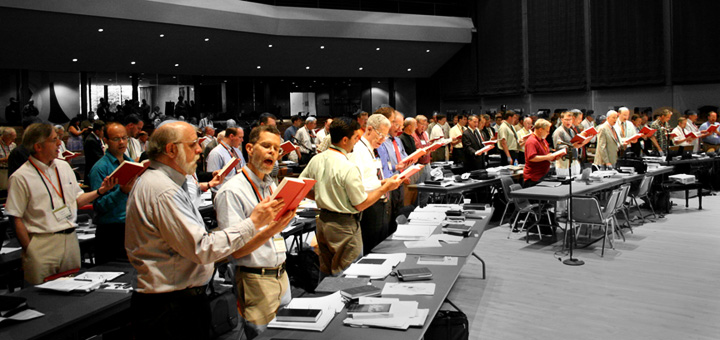
Mr. Eckardt called the day's session to order with prayer, and we sang a rendition of Psalm 126. For me, one of the unexpected but unbridled joys of the Assembly is hearing 150 men join together in song. It is hard not to feel the electricity of so many voices prayerfully singing:
Again refresh us, Lord, with your reviving love, And be your blessing poured in mercy from above; By grace revive our hearts again, As streams refreshed by copious rain.
The moderator took a moment before the Assembly began its business by reading for us Romans 12, a call from Paul for dedicated, humble service. He reminded us of Wednesday's pre-Assembly conference, encouraging us to deliberate with love and wisdom born of prayer.
To accommodate scheduling conflicts, the order of the day at the outset of this morning's session was the presentation of the report of the Committee on Pensions, by Committee president Roger Huibregtse. After briefly reminding the Assembly of the Committee's charter to provide retirement, health and life insurance plans for ministers, officers, and full-time employees of the OP churches. The plan, currently servicing 256 participants, is healthy and continues to increase in value, benefiting both contributors and pension recipients alike. By way of recommendation, the Committee asked the Assembly to request that congregations contribute $20 per communicant member to the Hospitalization Reserve Fund in 2008.
Next, the stated clerk of the Assembly, the denomination's trustees, and the denominational statistician presented their reports, in that order. The Rev. Donald Duff, though acknowledging the periodic tedium of his responsibilities as the stated clerk, more than anything wanted to express his gratitude to us! "Thank you," said Mr. Duff, "for letting me serve the church in this way." Indeed, it is the church that owes a debt of gratitude to Mr. Duff for 15-plus years of faithful service as clerk. Mr. Richard Barker, an elder from Westfield, New Jersey, and president of the Trustees, pointed the Assembly to his written report. Our statistician, Mr. Luke Brown, provided a wealth of information that speaks volumes to God's grace to the OPC. Though small by most measures, we continue to grow: at the end of 2006, we had 28,486 members, a total which represents an all-time high for the OPC. We have 255 congregations (with an average size of 112 members), and we have 57 active mission works. Our collective giving is up 12.6% from 2005, to $45.9 million annually. This translates into $2,251 per member, another all-time high. Praise God for his goodness to us, and let our prayer be that he continues to grow his church in his time.
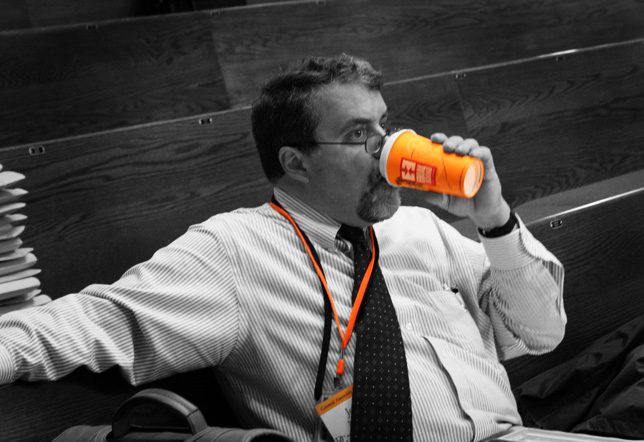
Listening to deliberations
 |
After the morning break, the Assembly turned its attention to the work of the major program committees, the first reporting being the Committee on Home Missions and Church Extension. The Rev. John Hilbelink, the Committee president, introduced the report and pointed out for us the several church planters and regional home missionaries that were either commissioners or present at the Assembly. He also gave a heartfelt thanks to the staff of the Committee that daily works to ensure that our church planting efforts are supported. The Rev. Ross Graham, the Committee's general secretary, spoke briefly on broader issues regarding the work of the Committee. Of note is that the traditional line of separation between the work of the Committees is becoming "more blurred." This is a good thing: men have seamlessly moved between foreign and home fields, and Christian Education is publishing multi-lingual study materials for use at home and abroad. Mr. Graham's plea was to focus support efforts not to CHMCE directly, but on Worldwide Outreach, to sustain the "blurred lines, which makes the church stronger." The Rev. Dick Gerber, associate general secretary of CHMCE, presented details of the report, and introduced three church planters: David Harr, from Medford, New Jersey, George Barros, from Toronto, Ontario, and David Smiley, Bradenton, Florida. Each addressed the Assembly about the work of God in those cities.
I've taken a chronological liberty to complete the summary of CHMCE, but the report itself was interrupted by the Assembly's daily devotional and the mid-day lunch recess. The Rev. Alan Strange read for us from Philippians 2. The reminder that "we are called to be servants of the servants of God" stood as a centerpiece to Mr. Strange's message. Indeed, all believers are called to serve with rejoicing all the days of our lives, but ministers and elders are to serve sacrificially as servants of the servants of God. Certainly, this notion runs in contrast to today's culture, which calls us to be self-serving, giving little heed to the needs of others. But in verse 17 Paul drives us to recognize our duty. And this duty should never be drudgery. Even as Paul was being poured out as a drink offering, he rejoiced. His attitude, the attitude of Christ, should be ours. And our prayer must be that we serve those who serve:
Jesus, with thy church abide, Be her Savior, Lord, and Guide, While on earth her faith is tried: We beseech thee, hear us.
After lunch and the completion of the CHMCE report, the Committee on Foreign Missions headed to the podium. The Rev. Paul Browne, a Committee member, introduced CFM and its report on behalf of the Committee's president, the Rev. Richard Gaffin, who is not present at the Assembly. Again, after a brief note of thanksgiving to those who serve this important committee so well, Mr. Mark Bube, the general secretary of the Committee, presented the full report. A slide show of pictures from the ten fields served by OPC missions accompanied Mr. Bube's discussion. The church is active in Ethiopia, Haiti, Japan, Korea, Canada (Quebec), Suriname, Uganda, and Ukraine. Highlights included presentations from the Reverends Brian Wingard and Tony Curto. Mr. Curto captured our attention, recalling the success of the Gospel, and using Isaiah's response to God's call as a plea to any here who might pick up the mantle of service abroad: "Here I am. Send me!"
CFM's report also contained a memorial resolution which was adopted by CFM, giving thanks to God for the faithful service of Matthew Baugh who was tragically killed on May 4, 2006 in a motor vehicle accident while on the field in Haiti. Mr. Bube read the resolution in its entirety.
With the few minutes left before the evening meal recess, the moderator called for the Committee on Christian Education to begin its report. Introducing the report was the Committee president, Dr. Jim Gidley. Dr. Gidley read from Romans 6:17-18, emphasizing the importance of teaching and noting that Paul provides a sound basis for all that CCE does on behalf of the church.
The Rev. Danny Olinger, the general secretary of the Committee, gave thanks to the Assembly for their prayers over the last two weeks. Two weeks ago, he had an emergency appendectomy; before the surgery it was discovered that he has a rare blood disorder. But, God is good; Mr. Olinger is recovering and thankful that he was able to attend the Assembly.
Presenting the APRV
 |
After dinner, a major order of the day commenced, as the Committee on Revisions to the Directory for the Public Worship of God has reserved Friday evening's session and all Saturday's sessions for the discussion of the Amended Proposed Revised Version of the Directory for Public Worship (APRV). The Rev. George Cottenden, the Committee chairman, provided for us a brief history of the project that has been underway for 18 years. Mr. Cottenden gave thanks to all of the Committee, whose tireless labors of immeasurable hours have brought us to this day. He called special attention to the service of the Rev. John P. Galbraith, who, for health reasons had to resign from the Committee last fall. He noted that Mr. Galbraith served for some 50 years on committees involved in the revision and perfection of our constituting documents.
A series of procedural recommendations were approved; these were offered by the Advisory Committee responsible for reviewing this committee's work as a way to aid the Assembly in its deliberation of the document. Most significant was the requirement to consider the APRV seriatim, section by section. This means that we will consider the document in chunks, and allow for amendments to the section under consideration. The procedure also allowed for a general question and answer periodthis gave the opportunity for commissioners to ask the Committee specific questions regarding the documentwhich was especially helpful for clarifying changed or new language in the document. If the document gains the Assembly's acceptance, it will be "approved for proposal to the presbyteries." At that point, two-thirds of the presbyteries will have to approve the document, and then it would be adopted by the church in 2010. But before 2010, we have to get through tonight.
Interim Update (mid-day, Saturday June 16, 2007)
To catch up on a few items that have been omitted thus far, I have neglected to report on elections. To simplify, I'll present the results by committee, in the order of reports presented on the floor:
Committee on Pensions:
Class of 2010: Robert Meeker (elder) and William Reddington (elder)
Class of 2009: John McGowan (minister)to fill an opening created by a resignation from that class
Trustees:
Class of 2010: Martin L. Dawson, Sr. (minister); Edward K. Tress (elder)
Committee on Home Missions and Church Extension:
Class of 2010: George Knight, Donald Poundstone, and Gerald Taylor (ministers); Robert Ayres and Gregory Dejong (elders)
Committee on Foreign Missions:
Class of 2010: William Kessler, John Mahaffy, and John Van Meerbeke (ministers); Luke Brown and Robert Joss (elders)
Additionally, Mr. Luke Brown was re-elected to serve as statistician.
In the listening mode
 |
I have also neglected to report on the several fraternal delegates present at the assembly. Several men from other denominations have been present at our assembly. These include: the Rev. Dirk van Garderen, Reformed Churches of New Zealand; the Rev. Ralph A. Pontier, the United Reformed Churches of North America; the Rev. Kevin Backus, the Bible Presbyterian Church; the Rev. Rowland S. Ward, the Presbyterian Church of Eastern Australia; the Rev. Richard E. Pot and Mr. John Jonker, the Canadian Reformed Churches; the Rev. Peter J. Naylor, the Evangelical Presbyterian Church of England and Wales; the Rev. Douw Breed, Reformed Churches in South Africa. All of these men were seated as corresponding members of the Assembly. Thus far, Mr. Pontier, Mr. Pot, and Mr. Backus have had the opportunity to address the Assembly on behalf of their respective denominations.
We are in the midst of our deliberations regarding the Amended Proposed Revised Version of the Directory for Public Worship (APRV). I will have an update on today's proceedings later.
Thank you for your prayers on behalf of the entire Assembly.
Saturday June 16, 2007 (Part II)
The moderator began the day by helping the Assembly understand the rules of engagement for considering a document seriatim, pointing out some of the subtleties and complexities of the debate in which we are engaged (the consideration of the Amended Proposed Revised Version of the Directory for Public Worship [APRV]). There was some question on these subtleties last evening, as the procedure we adopted contained language that confused many. The recommendation embraced last night read: "The Assembly shall consider and approve the APRV seriatim section by section." The placement of the clause "and approve" became a sticking point. When something is considered seriatim, the considering body debates and amends a document progressively, but nothing is approved until the entire document has been walked through section by section AND another season of amendment on the entire document is concluded. The adopted procedure seemed to indicate interim approvals, which is not the case. Last night, we worked through the notion of when approval must occur, and this morning, we were reminded that as we step through the document, debate is not limited to offered amendments. Absent an amendment, commissioners may take up a debate for and or against a section or a clause in that section. While this may seem a fine point, the rule allows commissioners some latitude to interact with a section in toto. Though we thought we made it through the Preface of the APRV last evening, debate was limited to proposed amendments; the moderator corrected this procedural oversight and this morning another brief discussion about the Preface to the APRV ensued.
At issue in the Preface to the APRV is the attempt by the Committee to clarify some nuanced language that exists in the current DPW and has been carried over to the new. Following the regulative principle of worship, the DPW mandates certain practices within the worship service. In the DPW and the APRV, these practices are typically invoked with words like "shall," "will," "is to be," "must," or "are to be." For example, "the principles of public worship must be derived from the Bible" (APRV I.B.6.a). Yet there are other practices that are more "circumstances of worship" or tangentially related to worship that must be considered, and in these there is some room for variety among OPC congregations. For certain things (furniture placement, for example), we don't have a clear directive from the Bible, but we can deduce a preference based on our principles. For example, "Because musicians and musical instruments serve the part of worship that is performed by the congregation, it is advisable that they be positioned with or behind the congregation" (APRV I.C.4.b).
Digesting the debate
 |
The APRV attempts to delineate these other practices into classes. Together with things that are mandated, there are 1) practices that are not mandated, but strongly recommended; 2) practices that are commended as suitable; and 3) practices that are permissible. Each class carries with it a weightiness that is borne out by the language used to describe that class. These definitions are intended to assist sessions in making decisions about worship as they clarify language already employed in the DPW, but in the process of clarification, a fine tuning emerges in the APRV that did not exist before. It is not surprising that some of the amendments that have been proposed to us today speak directly to the class to which a practice properly belongs.
Discussions about the Preface occupied only a small portion of our time this morning. There being eighteen sections total (plus three forms for special services), there was much ground to cover. We moved on to Chapter I, The Principles of Public Worship, which contains four sections: A. God's Institution of Public Worship; B. The Nature of Public Worship; C. The Parts of Public Worship; and D. The Oversight and Conduct of Public Worship. I did not count the number of proposed amendments, but there were manysome substantive, others not. In general, the prevailing mood of the Assembly seemed to be to defer to the collective wisdom of the DPW Committee and the Advisory Committee assigned to the APRV. In debates like this one, the recommendations of an AC prove very helpful. While the Assembly is not bound by such recommendations, prudence often dictates that we at least pay attention to them. Notably, the AC responsible for reviewing the APRV work was "silent" on the four sections in Chapter I. "Silence" in this context is to be understood as "general approval of the work and concurrence in the recommendations." The Assembly was not quick to disregard the AC's advice. Don't misconstrue this to mean that there were not perfections passedthere were, and there were several attempts to amend the document. The debate was sincere, and the discussion godly. But at the end of the day, there were no substantive changes to Chapter I, which is where discussions concluded.
Oh, and it isn't every day that you hear someone use "codified" and "tertiary" in the same sentence.
I will circle back on Monday and provide the remaining details on today's deliberations. Tomorrow is a splendid and much needed day of rest. Keep the Assembly in your prayers as you join together as God's people to worship our King.
Saturday June 16, 2007 (Supplemental)
My last report had a limited focus, and I did not expand beyond that focus, so that the details of the APRV discussion could be posted as soon as possible. This necessarily meant that I left out some items that deserve attention; hence, I offer this supplemental report for Saturday to provide some additional information about the day's proceedings.
A row of commissioners
 |
After our morning recess, the Rev. Kevin Backus, a fraternal observer from the Bible Presbyterian Church, addressed the Assembly. As reported earlier, the rest of the morning session was consumed with consideration of the APRV. At 11:55 a.m., however, we turned our attentions to the Assembly's daily devotional, and we were very much blessed as the Rev. David J. Harr opened for us God's word from Jeremiah 5. Seeing a godless Jerusalem, God sends his prophet on a mission to find a man who fears him, who does justice, who loves righteousness, and seeks truth. If such a man is found, Jerusalem will be spared. There is an obvious parallel here to Genesis 18, though there are differences. In Jeremiah, the mission is of God's initiative, the city is not the seat of paganism but instead God's holy city Jerusalem, and God asks for just one righteous man, not ten. This righteous man is not found, at least not in Jeremiah's day. But the Gospel tells us that the mission has been completed successfully. Jesus is that man, and the heavenly Jerusalem is spared. This is where we must put our confidence and hope:
My hope is built on nothing less Than Jesus' blood and righteousness; I dare not trust the sweetest frame, But wholly lean on Jesus' name.
Saturday afternoon we returned our collective attention to the APRV, though the Rev. Douw G. Breed, fraternal delegate from the Reformed Churches in South Africa, addressed the Assembly briefly after our afternoon recess.
At the end of the day, we had completed 5 of the 18 sections in the APRV. Facing a still-full agenda for the remainder of the week (several standing committees yet to report, one overture, and two appeals), the day ended with a motion to refer the "already-amended and not-yet-amended APRV and the report of the Advisory Committee ... to the 75th (2008) General Assembly and to the Committee on Revisions." If additional time opens up, we have the option to reconsider this motion and bring the APRV back to the floor, but, given the remaining docket, it seems unlikely. The presbyteries will have to wait until at least next year before the APRV is put in their hands.
Monday June 18, 2007
Our day began with the singing of the hymn "Blow Ye the Trumpet, Blow!"
Extol the Lamb of God, The sacrificial Lamb; Redemption through his blood, Throughout the world proclaim.
Our docket requires that we consider all overtures not already acted upon first thing Monday morning; hence, this was our first order of business. There was only one overture before the Assembly this year: the Presbytery of Northern California requested approval to change its name to the Presbytery of Northern California and Nevada. This change is in recognition of the fact that there are now three OPC congregations worshiping in Nevada. After no debate, the overture was granted.
The Committee on Christian Education returned to the podium to continue the report they began Friday evening. After brief introductions by Mr. Olinger, three important efforts of the CCE were presented. First, Mr. John Deliyannides, chair of the Subcommittee on Internet Ministries, reported on the status of OPC.org. Our Internet presence is becoming a more and more important part of our "face" to the world. For instance, in just the month of February, 2007 alone, over 32,000 visitors from 80 countries hit our site! Next, the Rev. Tom Patete presented the work of GCP, reminding the Assembly of the importance of this joint effort: "We all want to show our covenant children how to live, worship, and serve, and how to develop a Christian worldview. Our hope is that GCP publications will color their approach to every aspect of life." Lastly, Mr. David Winslow described plans for a covenant youth conference to be held in California. We as a church need to work proactively to encourage our young people toward consideration of the gospel ministry; this conference is designed to introduce to young people the blessings of such service. If deemed "successful" CCE plans on doing a similar conference on the east coast.
View of assembly floor from right side
 |
Mr. Olinger also reported on the recent publications of the Committee (Justification; What Is the Reformed Faith?) and how CCE's desire is to make as many resources available to the church as possible, including resources in different languages. The Ministerial Training Institute continues to provide critical supplemental training for both men seeking ordination and men already ordained. There are some concerns here, however, that warrant the prayers of the church. Not as many men under care are taking courses as is desirable, and the dropout rate has increased somewhat. Another prayer concern involves the year-long intern program. While there were 16 men desiring such internships this year, CCE could only help with the placement of 11. Pray that God will continue to raise up young men called to the ministry in the OPC, pray that those men will take advantages of the opportunities afforded them by the CCE, and pray that our churches will continue to work closely with CCE to expand those opportunities.
A final note: the CCE recommended to the Assembly to erect "to assist the Church in establishing a direction regarding the use of multiple languages in its various judicatories and ministries," to provide "principial and practical advice on how to deal with language differences in the Church." AC 2 recommended that this be recommitted to CCE for possible consideration to next year's GA, believing that there are other committees working on similar projects. The Assembly approved this recommendation.
After a brief morning recess the Assembly was addressed by the Rev. Dirk van Garderen, the fraternal delegate of the Reformed Churches of New Zealand. Yes, he worked in a reference to the beauty of his country and The Lord of the Rings trilogy.
The CCE concluded its report, and the following were elected to the Class of 2010: John Muether and James Gidley (elders) were returned to Subcommittee on Ministerial Training (a subcommittee elected directly by the Assembly; such election automatically returning them to the CCE); and Rodney King, Alan Strange, and Stephen Pribble (ministers) were also returned to the CCE.
Aerial view of assembly floor
 |
The Rev. Jim Bosgraf reported on the Committee on Coordination, which is the committee of the Assembly responsible for bringing "the goals, plans and budgets of these respective 'program' committees" together and presenting them in a "unified fashion to the General Assembly." Mr. David Haney, the director of finance and planned giving, related God's gracious provision to our Church: indeed, he views his position as an honor: it is "a privilege to see God work first hand; it is exciting, thrilling. There are down times when you don't see abundant blessings, but we must persist. You will see the Lord make provisions." The Rev. Ross Graham commented on the "state of the union," now that the financial rules governing the distribution of funds between committees have been in effect for 6 months (these rules were changed at last year's Assembly). One of the concerns coming out of last year was a loss of the "protections and the evenness" of the old rules. Under the new rules, would the program committees go separate ways in terms of funding their needs, or would they work as one, putting together a single message to promote the OPC's moving forward for a single cause under the guise of Worldwide Outreach? Mr. Graham enthusiastically reported that "we are stronger than ever in our unity. We have decided to work together, to have a common look and feel to our materials, to share the work and the costs among ourselves as committees, to work as one on how the whole church does the whole work of the Church."
The committee offered and the Assembly approved a budget for 2008. The Rev. Lawrence Semel and John D. Mazunik (elder) were elected to the class of 2010.
The Rev. Andrew H. Selle led the Assembly in our daily devotional. We started with a hymn, and then read Psalm 34 responsively. Mr. Selle concentrated on the end of verse 14, "seek peace, and pursue it," an admonition that is not a political statement, but a call to suffering. David, in the midst of suffering, experienced God's peace even when he didn't deserve it. So, too, we experience God's grace and peace when we suffer, and the imperative is a call to the cross. Peter, in his first epistle, quotes this Psalm in the context of suffering for righteousness. Peter commands the church to live in harmony, having the mind of Christ. We are to suffer with each other, and suffer with those who suffer.
It was a busy morning, and it continues to be a busy day. Much of what we may have lost in terms of agenda progress on Saturday has been made up in the last several hours. I will fill you in on the rest of the day in tomorrow morning's update, but, for now, I wanted to at least get you a picture of some of our progress today.
Please continue to keep us in your prayers.
Monday June 18, 2007 (Part II)
After lunch recess, the Rev. Rowland S. Ward, fraternal delegate from the Presbyterian Church of Eastern Australia, addressed the Assembly, expressing a deep appreciation for the OPC and heartfelt thanks for our relationship.
Mr. David Haney, president of the Committee on Diaconal Ministries, reported next. It has been a year of transition for the Committee: there were personnel changes at last year's Assembly, the Committee revised the Bylaws to reflect changing needs (previously, the offices of secretary and treasurer were combined), and the Committee is actively transitioning the major disaster relief program from Home Missions to the Committee. The Committee presented and the Assembly approved the Committee's recommendations, which included a request from the Assembly to congregations to give at least half of their diaconal contributions by May, and a budget for calendar year 2008. The Assembly returned the Rev. Ronald Pearce to the class of 2010, and elected David Nakhla (elder) to that same class.
The Rev. George Knight introduced the report of the Committee on Ecumenicity and Interchurch Relations (CEIR), and the Rev. Jack Peterson, the Committee's administrator, presented the report.
Mr. Peterson highlighted several Committee activities, including contact with the Orthodox Presbyterian Church of Columbia, which has sent an official communication to us, asking to be received as part of the OPC. CEIR, together with CFM and CHMCE, is in communication with the OPC of Columbia. Mr. Peterson also pointed out the guiding document used by CEIR in its work to establish relationships with other churches: "Biblical Principles of the Unity of the Church." Adopted in 1996, CEIR revised the document last year, and CEIR is working with CCE to bring the website up to date. Finally, Mr. Peterson encouraged ecumenical labors not just at the denominational level, but also among presbyteries and sessions. CEIR had two recommendations for the Assembly: 1) that the Assembly approve the membership of the Heritage Reformed Congregations in NAPARC (the North American Presbyterian and Reformed Council), and 2) that the OPC enter into a corresponding relationship with the Presbyterian Church of Eastern Australia. The Assembly adopted both recommendations. The Reverends Tony Curto, Bob Needham, and Peter Wallace were all returned to CEIR as the class of 2010.
The mid-afternoon recess was a welcome break after a long day of committee reports. After the break, the Rev. Thomas C. Shoger of the Associate Reformed Presbyterian Church brought greetings to the Assembly. He had been seated as a corresponding member earlier in the day.
Commissioners at work
 |
After the fraternal address, Advisory Committee 5, which had been assigned to review several communications received by the Assembly this year, presented its recommendations. The bulk of our discussion involved communications involving the relationship between Mr. Hailu Mekonnen, the Presbyterian Church of Ethiopia, the Middle East Reformed Fellowship, and the OPC. I cannot report more on this now, as much of the debate focused on the presentation of a substitute motion to the recommendation of AC, a substitute to that substitute, and some discussion regarding the procedural issues involved with these motions. The motions were not acted upon before our dinner break, and, as the consideration of the Committee to Study the Propriety of the Reception of Illegal Aliens was the order of the day for our evening session, we did not return to these communications on Monday.
Before the break, the Rev. Warren Gardner, fraternal delegate from the Free Church of Scotland (Continuing), was seated as a corresponding member. After the dinner recess, the Rev. Peter J. Naylor, the fraternal delegate from the Evangelical Presbyterian Church of England and Wales, addressed the Assembly. After this brief address, the report on the Committee to Study the Propriety of the Reception of Illegal Aliens was presented. The Advisory Committee suggested and the Assembly adopted a set procedure for reviewing the report. The procedure allowed 20 minutes for the Committee to present and 20 minutes for the Assembly respond to questions. The report is well written and thoroughly documented, and offers the following advice: "While a prima facie case might be made that many illegal aliens cannot make a credible profession of faith because of their apparent failure to submit to the governing authorities ... it is nevertheless appropriate for sessions to judge the credibility of a person's profession of faith based on a case-by-case basis." Hence, "it is not wise for presbyteries and sessions to determine in advance that a person's illegal status automatically disqualifies him from membership in the church, neither would it be appropriate to determine in advance that an illegal status is of no consequence... It should be the goal of presbyteries and sessions that as much as possible all members live as legal aliens or residents in keeping with Romans 13:1-2 and the implications of the fifth commandment (LC qq. 125-128) and the ninth commandment (LC qq. 144-145). It is therefore appropriate for the presbyteries and sessions to provide assistance to members seeking to change their status so that they may live as legal residents."
Tuesday June 19, 2007 (Part I)
The moderator called the Assembly to order at 8:32 a.m. The refrains of the opening hymn would prove sustaining for the day ahead.
O what wonder! How amazing! Jesus, glorious King of kings, Deigns to call me his beloved, Lets me rest beneath his wings.
It was a joy to sing, and then another to hear God's Word to us, as the moderator Romans 5:1-5: "And hope does not disappoint, because the love of God has been poured out within our hearts through the Holy Spirit who was given to us." Both served as apt reminders to look beyond ourselves, even when the waters we navigate are troubled. Tuesday proved to be an exceptionally difficult day.
The Assembly's work started out rather benignly with the reports of the committees responsible for reviewing presbyterial records and the records of the Assembly's standing committees. But when the Mr. Eckardt turned the gavel over to Mr. Robert Coie, the tone of the Assembly changed. We were to sit as the highest court in the church, and Mr. Coie admonished us as such. Mr. Coie assumed moderatorship because Mr. Eckardt had an interest in one of the appeals that was before the Assembly.
The first case before us came from Mr. Gregory Baus, who was appealing the decision of the Presbytery of Mid-Atlantic to uphold the sentence of excommunication rendered by First OPC in Baltimore, Maryland, against Mr. Baus. There were two questions before the Assembly. First, the presbytery erred "in misjudging Mr. Baus 'obstinate' in abstaining from the Lord's Supper," and second, that the presbytery erred "in misjudging that Mr. Baus had been made 'the object of deep solicitude and earnest dealing to the end that he may be restored.'" Procedurally, the Assembly decided it would be best to consider the second part of Mr. Baus' appeal first. The Rev. Glenn Jerrell served as Mr. Baus' counsel, and presented Mr. Baus' case before the Assembly. The Rev. Stuart Jones, former pastor of First OPC, spoke on behalf of the session and the presbytery. The Assembly granted Mr. Baus the right of the floor, swore him in, and he responded to questions from commissioners. After several hours of deliberation, the Assembly did not sustain Mr. Baus' appeal. Debate then turned to Mr. Baus' first specification of error: the Assembly did not sustain Mr. Baus on this count, either.
The debate spanned three recesses, concluding just before the dinner break. At the morning recess, the official annual Assembly picture was taken; a few amateur photos of that session at can be seen on the GA photo page. After the break, the Rev. Tracy E. Gruggett from the Reformed Church in the United States brought greetings and addressed the Assembly.
Intent upon the debate
 |
After morning deliberations finished, the Rev. Wayne Forkner brought the morning devotional after reading Revelation 20:11-14. He used the text as a backdrop to discuss some of the justification controversy faced by the church today, but also focused on what John had to tell us about justification in Revelation. In verse 12 he writes, "and the dead were judged ... according to their deeds." Here John refers "not to entrance into heaven, but instead [makes] an allusion to Daniel 7:10. These dead are not the physical dead but the spiritual dead." This is a judgment to perdition, based on the law of God. These dead stand condemned already under the covenant of works. The picture that emerges is that no one can stand, unless united to Christ. If our works are judged, we stand condemned with the dead. But when God judges Christ's works on our behalf, we have hope: "For we through the Spirit, by faith, are waiting for the hope of righteousness" (Gal. 5:5). We were justified when Christ rose from the grave. Let us be found in him.
The Rev. Warren Gardner, fraternal delegate from the Free Church of Scotland (Continuing), greeted the Assembly after our return from lunch; likewise, the Rev. Alan Mallory addressed the Assembly as the fraternal delegate of the Presbyterian Church in America.
A 6:30 p.m. order of the day returned us to discussion of communications related to MERF. At 7:18 p.m., our docket was still very full. We still have another appeal to consider this evening. It looks like this evening's session will be extended through at least the conclusion of that appeal. I'll bring you up to date on that later.
Tuesday June 19, 2007 (Part II)
After dinner, Mr. Eckardt resumed the moderatorship, and the Assembly returned to the consideration of communications from and about Hailu Mekonnen's relationship to the church. These matters were dispatched by the Assembly by 7:45 p.m., at which time Dr. James Gidley took the gavel as we returned to the Appeals and Complaints Committee. In order to ensure that we completed the items on our docket, a vote was taken to extend the day's session until the completion of the Committee's last item, a complaint brought by James and Andrew Duggan against the alleged delinquency of the Presbytery of Philadelphia in the handling of a discipline case. The Assembly remanded the case back to the Presbytery.
We finished at 9:30. I think all are looking forward to a bit of a lighter load tomorrow.
Wednesday June 20, 2007
Mr. Eckardt again resumed moderatorship, and we opened the day singing"Lift High the Cross."
Come, brethren, follow where our Savior trod, Our King victorious, Christ, the Son of God.
The Assembly returned to work, finishing consideration of the report of the Committee on Appeals and Complaints, offering prayer on behalf of those involved in the complaint yesterday, and then turning to elections for the class of 2010. The Rev. John W. Mallin was elected to this class, and the Rev. Thomas A. Foh was selected as an alternate.
The Committee on Chaplains needed to complete its report. The Rev. Richard Dickinson, a lieutenant colonel on active duty in the Maine Air National Guard, described for us current needs, especially focusing on the needs of national guard organizations. Please remember those serving in your prayers. Mr. Needham was returned to the Committee as the class of 2010.
Mr. John Muether and your author presented the reports of the historian and Committee for the Historian, respectively. Mr. Muether highlighted the E. J. Young reprint mentioned in last Thursday's report, as well as a new book just released by P&R, Seeking a Better Country, by D. G. Hart and Mr. Muether. Though not our book, the Committee purchased a number to sell at this year's Assembly. In terms of elections, the Rev. Brent Ferry was returned to the Committee.
The remainder of the morning session had to do with the completion of unfinished business, including a report from the Temporary Committee on Arrangements. An election was held, and ruling elder Rusty Copeland was returned to the Committee on Arrangements. Next, we approved the General Assembly budget for 2008, and finally, a resolution of thanks was offered on behalf of the Assembly to Dordt College, and to the many, many hands that helped make the Assembly go so smoothly. Finally, the advisory committee responsible for the APRV review had a few remaining motions related to the consideration of the APRV at next year's Assembly. A resolution of thanks was approved to the Rev. John P. Galbraith for nearly 50 years of service to the denomination on committees working on our constituting documents.
The minutes were read and approved and, at 11:50 a.m. today, the Rev. Robert Eckardt officially dissolved the Seventy-fourth General Assembly, calling the church back together on July 9, 2008 in Tacoma, Washington for the Seventy-fifth General Assembly.
What a difference a week makes! The clouds and rain of last Wednesday have given way to a gorgeous day of warmth, sun, and low humidity. As we leave this place, we all thank God for his graciousness to all, for his patience and lovingkindness to us in spite of our weaknesses, and the special care that he has bestowed upon the Orthodox Presbyterian Church.
For why? The Lord our God is good, His mercy is forever sure; His truth at all times firmly stood, And shall from age to age endure.
The Assembly worships in song
 |
David K. Thompson is a ruling elder at Immanuel OPC in Oakdale, Pennsylvania and a member of the Committee for the Historian.
|