
Ministries
Resources
Michael Horton
Reviewed by: Shane P. Lems
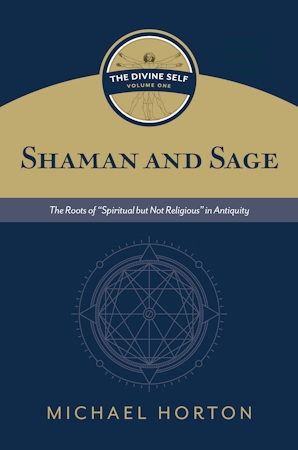
Shaman and Sage: The Roots of “Spiritual but Not Religious” in Antiquity, by Michael Horton. Eerdmans, 2024. Hardcover, 528 pages, $64.99. Reviewed by OP pastor Shane P. Lems.
“What has been done will be done again; there is nothing new under the sun” (Eccl. 1:9 NIV). This well-known statement from Scripture has been oft quoted for good reason. As one sorts through the various modern religious ideas, beliefs, and practices, it is impossible to find something that is entirely novel. In various ways, all modern religious beliefs and spiritualities are recycled and repurposed from the past. Michael Horton argues this point well in Shaman and Sage. This is the first volume of Horton’s upcoming three-part series that gives the background, description, and evaluation of the prevalent modern “spiritual but not religious” mindset.
In Shaman and Sage, Horton does a deep dive into ancient religious and philosophical beliefs and movements. He notes that the modern spiritual emphases on self, experience, autonomy, oneness, etc., are also found in ancient cultures. Horton argues that around the sixth century BC, religions shifted from the public, external realm toward the private, personal, internal realm—the divine self, the religion of the One (9, 106, 123). Because of the massive religious and philosophical changes during this time, historians call this the “axial age.” However, as Horton notes, the “axial age” was not just an event that happened and is now over. He believes “it is an ongoing process that is frequently identified with modernity” (388). In other words, the effects of this axial age are still felt today.
There are eleven chapters in Shaman and Sage. Each chapter focuses on different aspects of ancient religions and philosophies that also appear in modernity and post-modernity. For example, in chapter 2, Horton explains in detail how the Greek legend of Orpheus morphed and greatly influenced later religious thought. For one more example, chapter 7 is a lengthy discussion of ancient Gnosticism, including the Sethian and Valentinian schools of gnostic thought. In this chapter, Horton gives six main beliefs of ancient Gnosticism as well as a summary of Plotinus’s teaching. Other chapters cover topics like Platonism, Dionysus, Proclus, Origen, Hermes Trismegistus, and so on.
Shaman and Sage is packed with detailed information about ancient religions, spiritualities, philosophies, rites, myths, and practices. This book is almost like a short encyclopedia of the religious history of the spiritual self. Horton discusses concepts like monism, Orphism, panentheism, Taoism, theogonies, reincarnation, and others. He also elaborates extensively on past teachers, their teachings, and the various views of their followers. There are three helpful indexes (subject, author, and bibliography) for readers who want to track down certain concepts that Horton covers in this book.
Shaman and Sage is not meant for the average reader. Some of the discussions are extremely thorough and technical. If you want an introductory, easy-to-read book about the history of self-centered spirituality and religion, this is not that. But if you’re up for an academic exercise to expand your understanding of this topic, you’ll appreciate Horton’s insights and evaluations. You’ll also appreciate the comparisons and contrasts between Christianity and ancient religions/spiritualities. Indeed, there’s nothing new under the sun. Horton is right: the prevailing modern spiritual focus on the self, the One, is also found in the annals of history.
September 13, 2026
September 06, 2026
August 30, 2026
John Calvin’s Illustrated Institutes, Book 1
August 23, 2026
August 16, 2026
August 09, 2026
August 02, 2026
© 2026 The Orthodox Presbyterian Church


