
Ministries
Resources
David VanDrunen
Reviewed by: Andrew J. Miller
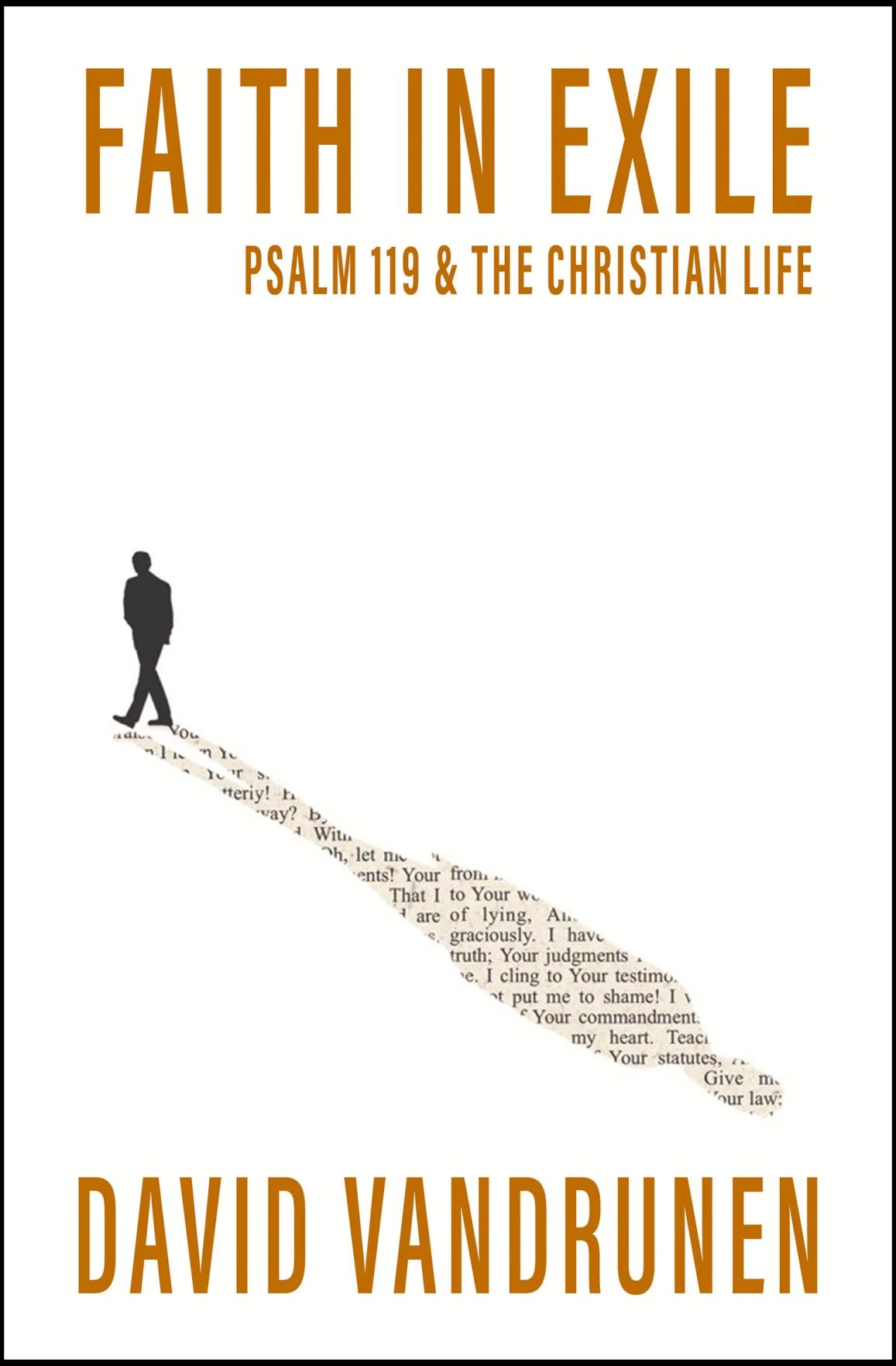
Faith in Exile: Psalm 119 and the Christian Life, by David VanDrunen. Christian Focus, 2025. Paperback, 160 pages, $12.99. Reviewed by OP pastor Andrew J. Miller.
If your enthusiasm for God’s Word wanes, read Psalm 119. This was Hywel Jones’s advice to me and other students in his pastoral ministry class at seminary. At that time, I found reading Psalm 119 discouraging: Even as a seminary student who loved God’s Word and wanted to preach it, I knew I fell short of the zeal and lifestyle expressed there. Thankfully, I grew to see that Psalm 119 reveals a love for God and his Word that acknowledges personal shortcomings. It expresses faith seeking understanding, like the cry of Mark 9:24, “I believe; help my unbelief.” Psalm 119 ends this way: “I have gone astray like a lost sheep; seek your servant” (Ps. 119:176).
David VanDrunen’s new work, Faith in Exile: Psalm 119 and the Christian Life, hits these same notes, explaining “the Great Psalm” as “a coherent, logically organized, Christ-centered poem written by a godly and brilliant poet” (9). Although VanDrunen’s professorial field is systematic theology rather than biblical studies, a pastor’s heart shines through this collection of sermons going through Psalm 119 two stanzas at a time. I would venture to say that this work showcases what draws so many to OPC pews: rigorous study put in a simple and winsome format, pointing to Christ and applied to the hearts and situations of God’s people.
The title Faith in Exile gives away that VanDrunen sees the author of Psalm 119 as a sojourner, possibly one of the Babylonian exiles (93–94). This provides a clear bridge to our situation as exiles (1 Pet. 1:1; Phil. 3; Heb. 13). While older commentators like Calvin attribute the psalm to David, the Bible does not identity its author, making all such identifications speculative. However, VanDrunen notes “some features of Psalm 119 suggest that a king of Israel, someone in the line of David, may have written it” (18). The fact that Psalm 119 does not reference “Abraham, Isaac, and Jacob” or “the exodus from Egypt, the covenants, the temple in Jerusalem, or the throne of David” (14) lends further credence to an exilic setting and non-David authorship. Of course, David himself experienced a kind of exile too, first on the run from Saul and later from Absalom. So even if one prefers a Davidic, pre-exilic background for Psalm 119, there is much here to appreciate. For example, here VanDrunen offers warm pastoral counsel: “Take heart that you will not be sojourners forever. You are citizens of heaven now and one day you will be residents too. You walk by faith now but soon you will walk by sight” (36).
Perhaps the most striking difficulty in explaining Psalm 119 is its structure: It is challenging to perceive a coherent flow. Part of this may be the nature of acrostic poems, and VanDrunen suggests that the psalmist “repeatedly circles back to many of the same themes . . . to mirror the spiritual life of a sojourner” (51). Our lives feature the interpenetration of joy and pain, just as this Psalm is viewed as a lament even though at points it erupts in effusive praise for God’s Word (see 74).
Faith in Exile is not a commentary on Psalm 119 and so does not touch on every question raised by it. One can only cover so much in a sermon. However, the book lives up to its subtitle: It well applies Psalm 119 to the Christian life. It should be a welcome addition to your bookshelves.
September 27, 2026
September 20, 2026
Track: A Student’s Guide to Church
September 13, 2026
September 06, 2026
August 30, 2026
John Calvin’s Illustrated Institutes, Book 1
August 23, 2026
August 16, 2026
© 2026 The Orthodox Presbyterian Church


