
Ministries
Resources
Brian E. Coombs
Reviewed by: James S. Gidley
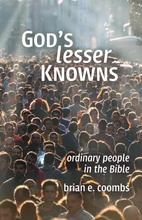
God’s Lesser Knowns: Ordinary People in the Bible, by Brian E. Coombs. Crown & Covenant, 2025. Paperback, 304 pages, $16.00. Reviewed by OPC elder James S. Gidley.
The epistle to the Hebrews tells us to be “imitators of those who through faith and patience inherit the promises” (Heb. 6:12). In God’s Lesser Knowns, Brian Coombs explains how that faith and patience worked itself out in the lives of his fourteen biblical subjects. In each case, he focuses on a particular gift of grace exemplified in the subject; for example, loyalty (Ittai), faith and contentment (Naaman’s captive girl), hospitality (Mnason), and election (Rufus).
The book reads like a sermon series that has been transcribed for publication. The audience in view is a congregation of God’s people, making God’s Lesser Knowns suitable reading for all church members.
There is a danger involved in focusing on the graces of biblical characters: One can easily fall into moralism. However, Coombs maintains a strong focus on the gospel and the centrality of Jesus Christ. In his first chapter, on Agur (Prov. 30:1), he highlights Agur’s humility and desire to know God and his Son. He leads the reader to this point: “In repentance and faith, then, exchange your sins for Christ’s own garments of righteousness, to cover your shame and clothe your nakedness” (18).
Another challenge that Coombs successfully handles is the limited biblical data available for each of his subjects. All that we know about some of them is contained in a single verse: for example, Antipas (Rev. 2:13), Mnason (Acts 21:16), and Rufus (Rom. 16:13). The temptation is to indulge in speculation, but Coombs carefully surveys the context in each case and draws on parallel Scripture texts.
Finally, I would reflect on the author’s underlying concern: “Are you content to be unknown in the world’s eyes? Do you wonder how significant your life really is in God’s purpose?” (xiii). Coombs means to encourage believers who feel that their lives are insignificant, presumably because of their lowly stations in life or their lack of opportunities for meaningful service. Therefore, he puts on display people who seem to be insignificant in the pages of Scripture. However, I wonder if our sense of insignificance stems largely from our sense of failure to be the kinds of people who adequately exemplify the graces of God’s lesser knowns. In other words, “we all stumble in many ways” (James 3:2).
Therefore, in striving for “the holiness without which no one will see the Lord” (Heb. 12:14), it is good to reflect on the fact that our best works are “mixed with . . . much weakness and imperfection” (Westminster Confession of Faith 16.5).
Notwithstanding, the persons of believers being accepted through Christ, their good works also are accepted in him; not as though they were in this life wholly unblamable and unreprovable in God’s sight; but that he, looking upon them in his Son, is pleased to accept and reward that which is sincere, although accompanied with many weaknesses and imperfections. (WCF 16.6)
Nevertheless, I recommend God’s Lesser Knowns to all readers who are serious about growing in Christian character.
October 11, 2026
October 04, 2026
September 27, 2026
September 20, 2026
Track: A Student’s Guide to Church
September 13, 2026
September 06, 2026
August 30, 2026
© 2026 The Orthodox Presbyterian Church


