Ministries
Resources
Matthew C. Bingham
Reviewed by: Harrison Perkins
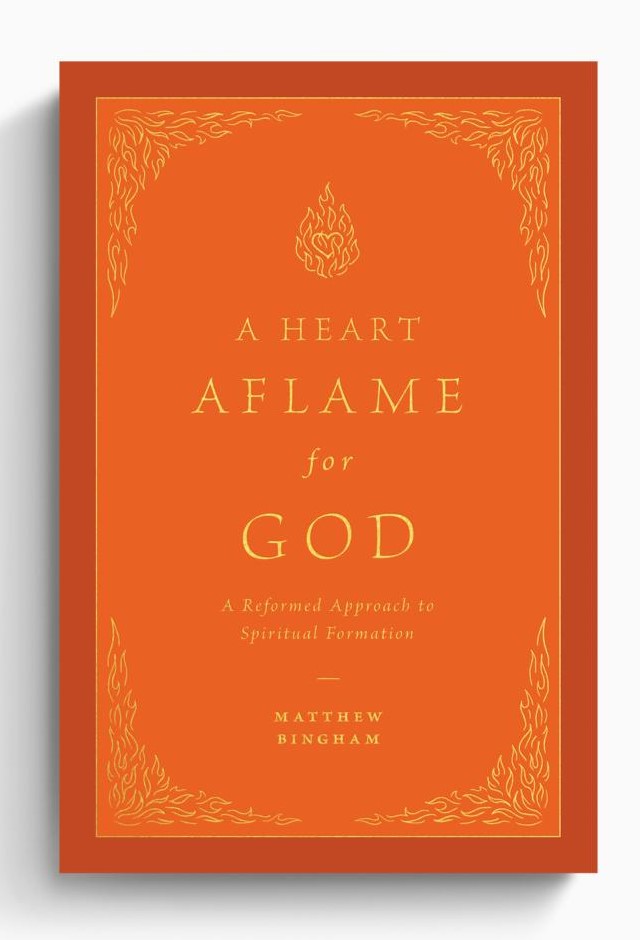
A Heart Aflame for God: A Reformed Approach to Spiritual Formation, by Matthew C. Bingham. Crossway, 2025. Hardcover, 368 pages, $32.99. Reviewed by OP pastor Harrison Perkins.
The manifesto A Heart Aflame for God contends that traditional Reformed practices remain the best approach to personal piety. Musing upon the maxim “keep your heart” throughout this book, Bingham articulates the rationale for and benefit of multiple disciplines for our spiritual formation.
This book’s key concern is about the trajectory of modern approaches to spiritual formation that undermine traditional, Reformational approaches. Modern spirituality manuals focus on busyness to the expense of practices that form the heart through intellectual and affectional appeals. In this respect, Bingham nobly contends for a contemplative life reflecting on God’s Word in prayer and meditation as well as consideration of our place in the world through self-examination, pondering nature, and Christian relationships.
Perhaps most notably, Bingham mounts a phenomenal case against James K. A. Smith’s project about spirituality through physical routines. Bingham takes apart Smith’s logical flaws and shows how Smith’s whole premise is anti-Reformational in its assumptions.
Bingham also masterfully takes description of spiritual disciplines in principle to practical outworking. Too many books on the topic paint aspirational portraits of spirituality with no advice for how to achieve them nor recognition of the challenges. Bingham succeeds where others have failed.
With these unqualified commendations in place, I would still ask Bingham two questions. First, from a historical perspective, could we have had clearer understanding of what unites the sources used? While leaning foremost on “puritan” writers, Bingham invoked theologians from England, Scotland, the Netherlands, and America, ranging from the sixteenth century to twentieth. What unites John Owen, Samuel Rutherford, Campegius Vitringa, Charles Spurgeon, Jonathan Edwards, Herman Bavinck, and C. S. Lewis into a meaningful category? Bingham is incredibly well read, especially as he leverages these older sources in conversation with modern thinkers. I am not sure that even he would categorize every figure to whom he appeals as Reformed. This book does argue for a Reformed approach to spiritual formation, though. This reviewer at least would raise objections to the repeated appeal to Richard Baxter as if he were a fully reliable representative of mainstream Reformed theology.
Second, from a spirituality perspective, has Bingham gone far enough? He contends for these disciplines as “means of grace.” Nevertheless, this book explicitly omits robust discussion of the church and her sacraments. Within this scope, even the focus on our use of Scripture and prayer is more personal. Bingham’s case would be stronger had he anchored these disciplines in their foundational place in the life of the institutional church. As it stands, these practices seem to lead toward the church’s gathered life. In traditional Reformed theology, the means of grace in the church’s assembly are the starting point for the practice of personal piety. However reasoned this omission was, Bingham would have gone further in overturning the individualist, non-churchly approach to spiritual formation that concerns him had he grounded these personal disciplines first in the church’s corporate life in using the means of grace.
Leaving these questions for readers to ponder as they read Bingham’s work, we should end by noting that the best road into those ponderings is by reading his book. Bingham’s book will help and enrich you as a refresher about the importance of using God’s gifts to tend to our hearts as we walk with Christ.
September 27, 2026
September 20, 2026
Track: A Student’s Guide to Church
September 13, 2026
September 06, 2026
August 30, 2026
John Calvin’s Illustrated Institutes, Book 1
August 23, 2026
August 16, 2026
© 2026 The Orthodox Presbyterian Church


