
Ministries
Resources
O. Palmer Robertson
Reviewed by: Everett A. Henes
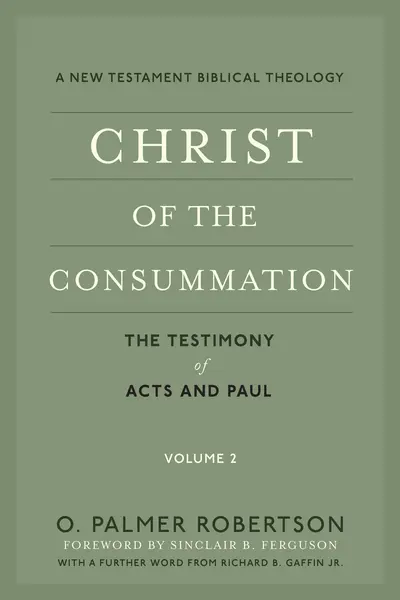
Christ of the Consummation: A New Testament Biblical Theology, volume 2: The Testimony of Acts and Paul, by O. Palmer Robertson. P&R, 2025. Paperback, 576 pages, $22.99. Reviewed by OP pastor Everett A. Henes.
Christ of the Consummation, volume 2: The Testimony of Acts and Paul is the ongoing scholarly work of O. Palmer Robertson. The author is considered by many to provide a formative approach to Scripture and covenant theology that has shaped the last generation of Reformed scholars and pastors. Robertson’s writings span biblical theology, covenant theology, prophecy, the Psalms, the New Testament, and pastoral application. But one clear thread holds his entire corpus together. You can see this same theme whether he is writing The Christ of the Covenants, The Flow of the Psalms, The Israel of God, Christ of the Consummation, or his commentaries. Robertson’s works are held together by a covenantal, Christ-centered, redemptive-historical reading of Scripture that sees the whole Bible as one unfolding story of God’s sovereign plan of redemption, culminating in and governed by the exalted Christ.
Robertson sees Acts and Paul not simply as historical or theological artifacts, but as testimonies to Christ. That is, their writings are not detached theological reflections, but part of the ongoing apostolic witness to who Christ is and what he has inaugurated. Indeed, the whole of Acts and Paul is the outworking of Christ’s command in Acts 1:8 that his disciples will be his witnesses to the ends of the earth—”only then will the programmatic design of Acts 1:8 for the gospel reach its final goal” (70).
The structure of the book itself reflects this redemptive-historical sweep. Part 1, “The Testimony of Acts,” opens with the outpouring of the Holy Spirit at Pentecost, signaling the “Inauguration of the Age of the Spirit.” Robertson then traces how themes first presented in the Gospels (what he calls “themes from Luke’s Gospel”) are expanded, developed, and fulfilled in the book of Acts. From there he examines apostolic preaching, early Christian proclamation, and how the historical progression narrated in Acts reveals the unfolding drama of redemption as God moves from Jerusalem to Rome, from Jew to Gentile, and from promise to fulfillment.
Part 2, “The Testimony of Paul,” offers a canonical reading of Paul’s letters in three phases: the early epistles (such as 1 and 2 Thessalonians, Corinthians, Galatians, and Romans), the so-called prison epistles (Ephesians, Philippians, Colossians, and Philemon), and finally the pastoral epistles (1 Timothy, Titus, and 2 Timothy). Through that tripartite division, Robertson demonstrates how Paul, always conscious of redemptive history, unfolds the implications of Christ’s consummation for the church, for gospel mission, for eschatology, and for pastoral order.
The volume is written in a flowing narrative style that draws the reader into the unfolding drama of redemptive history. Rather than presenting his insights in a rigidly academic or overly technical format, Robertson guides readers as fellow travelers, inviting them to trace the developing contours of the New Testament witness with him. The result is a work that feels less like a lecture and more like a guided exploration, richly theological, yet highly readable.
At the same time, the narrative form should not be mistaken for a lack of scholarly rigor. The volume is meticulously researched and generously footnoted, demonstrating Robertson’s careful engagement with both the biblical text and the wider field of scholarship. Every interpretive move is supported with precise documentation, allowing readers to follow his sources, assess his arguments, and appreciate the breadth and depth of his study. In this way, the book combines accessibility with academic integrity, making it useful for pastors, students, and scholars alike.
Robertson writes as a pastor-theologian whose scholarship is never detached from the life of the church. Even in his most technical works, he maintains a deep concern for how Scripture shapes a covenant people. For him, covenant theology is not merely an academic framework but the foundation for the church’s worship. Biblical theology is meant to guide and form the Christian life. The consummating work of Christ calls the church to live in hope and obedience, and pastoral application is always rooted in the unfolding drama of redemptive history. Thus, Robertson’s writing, scholarly as it may be, remains consistently pastoral, devotional, and oriented toward the health and holiness of Christ’s people.
Because Robertson refuses to turn the gospel into a set of abstract ideas, and instead presents it as real history and the sovereign work of God unfolding in time, readers are able to see much more clearly how the whole story of Scripture comes together in Christ. Pentecost, the preaching of the apostles, the spread of the gospel to the Gentiles, the planting of new churches, and Paul’s letters to ordinary Christians facing ordinary struggles—all of these become chapters in the one great story of God’s redeeming work.
Seeing Acts and Paul this way is especially helpful for pastors and teachers. In a day when Christianity is easily reduced to moral tips, vague spirituality, or isolated devotional moments, Robertson reminds us of the bigger picture. The gospel is not small; it is God’s world-reshaping work in Christ. And God’s people are not simply individuals trying to make it through the week, but a covenant community called to bear witness to Christ’s kingdom until he returns.
This book is a genuinely important contribution to understanding the New Testament. It builds on Robertson’s earlier work but also stands on its own, bringing Acts, Paul, and the life of the early church together in a way that is both deeply faithful to Scripture and deeply accessible. Few books manage to be this readable and this serious at the same time; pastoral without being shallow, scholarly without being intimidating.
For anyone who wants to see how the New Testament fits together, not as scattered stories and letters, but as one living testimony to the risen Christ, this volume is an excellent guide. And in a time when the church can easily lose sight of the big story of redemption, Robertson reminds us with clarity and conviction that God’s work in Christ is the greatest story ever told, and that we are invited to live within that story until the day he comes again.
November 22, 2026
Christ of the Consummation, vol. 2
November 15, 2026
November 08, 2026
November 01, 2026
October 25, 2026
The Genevan Réveil in International Perspective
October 18, 2026
October 11, 2026
© 2026 The Orthodox Presbyterian Church


